In the modern talent landscape, the “war for talent” has evolved into a “war for data integrity.” As we navigate 2026, the distinction between a Recruiting CRM (Candidate Relationship Management) and an ATS (Applicant Tracking System) is no longer just a technical nuance—it is a fundamental difference in recruitment philosophy.
For Talent Acquisition (TA) leaders and high-growth startups, choosing between these two systems (or integrating both) is the difference between a reactive “post-and-pray” model and a proactive, data-driven sourcing engine.
This 4,000+ word guide breaks down the mechanics, the ROI, and the 2026 decision matrix to help you audit your recruitment tech stack.
1. The Fundamental Philosophy: Reactive vs. Proactive
To understand the difference between a CRM and an ATS, you must first understand the workflow they were designed to serve.
The ATS: The System of Record (Reactive)
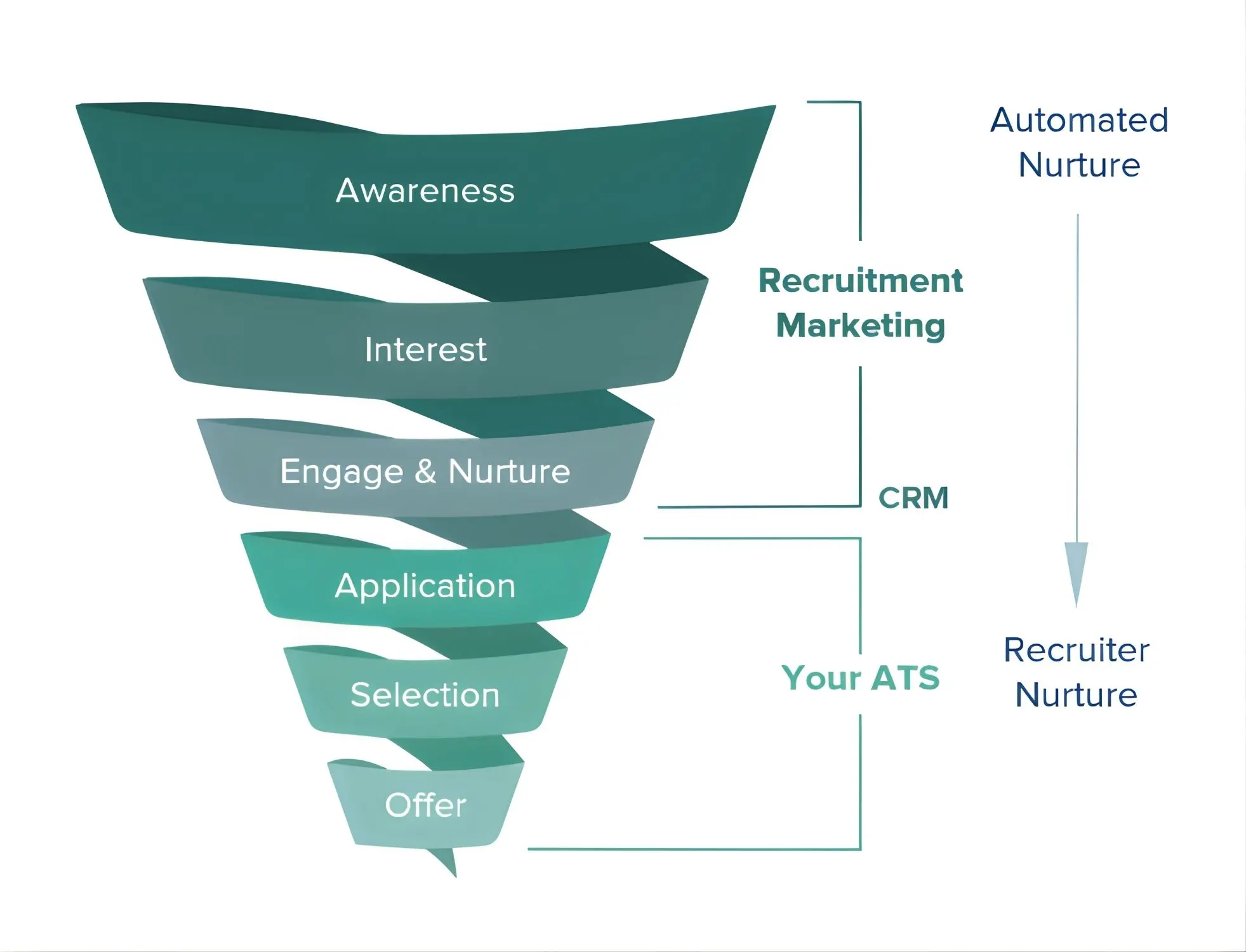
An Applicant Tracking System is designed to manage the active part of the hiring funnel. Its primary job is compliance, process management, and workflow automation for people who have already applied for a job.
- Primary Metric: Time-to-Hire.
- Core Function: Moving a candidate from “Applied” to “Hired” while maintaining a legal audit trail.
- Workflow: Linear. A candidate enters at the top, goes through interviews, and is either hired or rejected.
The CRM: The System of Engagement (Proactive)
A Recruiting CRM is designed for passive talent. It is a marketing tool for recruiters. Its job is to manage relationships with people who haven’t applied yet.
- Primary Metric: Pipeline Health & Source-of-Hire.
- Core Function: Nurturing interest over months or years.
- Workflow: Cyclical. A candidate might be “not interested” today, but through automated nurturing, they become your top hire eighteen months from now.
2. The Side-by-Side Feature Comparison (2026 Edition)
In 2026, the lines are blurring as modern ATS platforms adopt “CRM-lite” features. However, the depth of functionality remains distinct.
Pro Tip: Understanding the ‘CRM-Lite’ Gap
While many modern ATS platforms now offer “CRM-lite” modules, these are typically reactive communication tools rather than true engagement engines. For high-growth teams, relying solely on these features can create a “passive talent bottleneck.” They often lack the automated nurturing sequences and predictive AI mapping required to keep niche candidates warm over long hiring cycles. To maintain a competitive edge in 2026, ensure your tech stack supports proactive engagement—not just basic contact storage.
| Feature Set | Applicant Tracking System (ATS) | Recruiting CRM |
|---|---|---|
| Candidate Status | Active applicants only. | Passive, active, and “silver medalists.” |
| Primary Goal | Operational efficiency & Compliance. | Relationship building & Sourcing ROI. |
| Marketing Tools | Basic job board distribution. | Email sequencing, SMS, & landing pages. |
| Search Function | Basic keyword search in resumes. | AI-driven semantic search & talent mapping. |
| Analytics | Funnel conversion & Time-to-fill. | Engagement rates & Pipeline velocity. |
| Compliance | Strict GDPR/CCPA data retention. | Consent management for long-term nurturing. |
3. The “Silver Medalist” Rule: Where CRMs Win
One of the biggest failures in recruitment is the “Black Hole” of second-place candidates. In a traditional full-cycle recruiting process, you might find three exceptional candidates for one role. One is hired, and the other two—the “Silver Medalists”—are often lost in the ATS database, never to be contacted again.
A CRM solves this. Instead of these candidates disappearing, they are tagged and entered into an automated “Silver Medalist” nurturing sequence. When a similar role opens six months later, the CRM alerts the recruiter, allowing them to fill the role without spending a single dollar on new job postings. This is the ultimate ROI of a CRM: Recycling high-quality talent.
4. AI Capabilities: Automated Screening vs. Automated Sourcing
In 2026, AI is the backbone of both systems, but the application differs:
- ATS AI (Screening): Focuses on “Rank and Grade.” It uses LLMs to compare a resume against a job description and surface the most qualified active applicants. For more on this, see our breakdown of the best AI tools for candidate screening.
- CRM AI (Sourcing): Focuses on “Predictive Engagement.” It analyzes social data, LinkedIn activity, and past interactions to tell a recruiter when a passive candidate is most likely to be open to a new opportunity.
5. Compliance: GDPR, CCPA, and Data Retention
Data integrity is a legal requirement.
- ATS Compliance: Typically handles the “right to be forgotten” after a hire is made or a position is closed.
- CRM Compliance: Requires a more complex “Consent Management” engine. Since you are holding data for the long term, the CRM must automatically reach out to candidates to renew their consent to remain in your talent pool.
Failure to manage this correctly is a major risk in the RPO trends for 2025/2026, where agencies must prove their data handling is compliant across multiple jurisdictions.
6. Decision Matrix: When to Choose Which?
You need a better ATS if:
- Your recruiters are overwhelmed by a high volume of active applicants.
- Your “Time-to-Hire” is lagging due to manual scheduling and feedback loops.
- You have no clear audit trail for EEO/GDPR compliance.
- You primarily hire for evergreen, high-turnover roles where active candidates are plentiful.
You need a Recruiting CRM if:
- Your struggling to find niche talent (Engineering, Executive, specialized AI roles).
- You are spending too much on LinkedIn Recruiter seats every month.
- You want to build a “Talent Community” to reduce future agency spend.
- You rely heavily on outbound recruiting strategies to reach passive candidates.
7. The 2026 Integrated Tech Stack: Best-of-Breed vs. All-in-One
Many platforms today (like Greenhouse or Lever) claim to do both. While these “All-in-One” systems are great for SMBs, Enterprise TA leaders often prefer a “Best-of-Breed” approach—integrating a world-class CRM (like Beamery or Gem) with a robust ATS (like Workday).
Integration Checklist:
- Bi-directional Sync: Does data flow both ways? (e.g., if a candidate applies, does the CRM update their status?)
- Single Source of Truth: Which system owns the “Candidate Profile”?
- API Maturity: Can your sourcing team use Boolean search within the CRM and push those results directly to the ATS?
8. Conclusion: The Business ROI of Sourcing Tech
In 2026, the goal of recruitment technology is to move from transactional to relational.
An ATS handles the transaction of a hire. A CRM handles the relationship of a career. By leveraging both, you create a talent engine that doesn’t just “fill jobs” but builds a sustainable competitive advantage for your organization.
Ready to audit your recruitment tech? Master the full-cycle recruiting process by choosing tools that empower your recruiters to spend less time on data entry and more time on human connection.
Take the Next Step
Managing a complex CRM/ATS stack requires a specific set of recruiting skills. If your internal team is struggling to keep up with the tech curve, let Redirecruit help.$$Book a 2026 Recruitment Tech Audit with Redirecruit$$
to see how we integrate high-level CRM sourcing with efficient ATS tracking to deliver the top 1% of talent.
Related Reading:
- Strategic Interview Questions to Ask Candidates
- 17 Essential Virtual Assistant Interview Questions
- How to Sourcing on LinkedIn Like a Pro
Frequently asked questions
1. What is the primary function of an ATS (Applicant Tracking System)?
The primary function of an ATS is to serve as the “system of record” for the hiring process. It manages the logistical lifecycle of an active job applicant, from the initial application submission through to the final hire or rejection. Key features include automated resume parsing, interview scheduling, background check integrations, and ensuring legal compliance with labor laws like EEO and GDPR.
2. How does a CRM (Candidate Relationship Management) benefit recruitment?
A CRM benefits recruitment by enabling proactive “talent pipelining.” Unlike an ATS, which waits for candidates to apply, a CRM allows recruiters to source, engage, and nurture passive talent—people who are qualified but not currently looking for work. It benefits the organization by reducing long-term sourcing costs, increasing the quality of candidates, and building a “warm” community of talent that can be tapped into the moment a role opens.
3. How do I track candidates through different pipeline stages in a CRM?
Tracking in a CRM is done through “Talent Stages” or “Engagement Tracks” rather than “Interview Rounds.” Candidates are categorized by their level of interest and engagement (e.g., “Identified,” “Nurturing,” “Interested,” or “Silver Medalist”). Recruiters use automated sequences to send personalized content based on these stages, and AI-driven alerts notify the recruiter when a candidate’s engagement score increases (for example, if they have opened your last three emails or visited your careers page).
4. Is there an overlap between ATS and CRM functionalities?
Yes, the line is increasingly blurred in modern talent acquisition. While their core purposes remain distinct, the functional overlap is more common today than ever before:
>> The Modern ATS: Many platforms now include “Lite CRM” features, such as basic talent pools, automated email templates, and simplified landing pages for lead generation.
>> The Advanced CRM: Conversely, some high-end CRMs allow for simple status tracking and workflow management that closely mimics a traditional ATS.
However, it is important to remember that this overlap is usually surface-level. At its core, an ATS remains focused on the “administrative transaction” of hiring, whereas a CRM remains focused on the broader scope of “marketing engagement.”
5. Can I integrate a recruiting CRM with my existing ATS?
Absolutely. In 2026, most top-tier platforms are built with an “API-first” philosophy. This allows for bi-directional sync, meaning when a recruiter finds a candidate in the CRM and they finally decide to apply, their profile and all historical interaction data are automatically pushed to the ATS, creating a seamless transition from “prospect” to “applicant.”
6. Why might an organization integrate their CRM with an ATS?
Integration eliminates data silos and reduces manual entry. Without integration, a recruiter might hire someone through the ATS, but the CRM team would still be sending that person “nurture” emails about joining the company. Integration ensures that both systems share a “Single Source of Truth,” allowing for better candidate experience and more accurate reporting on which sourcing channels actually result in hires.
7. How does having both an ATS and CRM give a company a competitive edge?
Having both systems allows a company to master the “Total Talent” model. You aren’t limited to the people who happen to see your job post on a Tuesday afternoon (ATS). Instead, you have a proprietary database of the best talent in your industry (CRM) that you have spent months building relationships with. This dual-pronged approach results in a lower cost-per-hire, faster time-to-fill for niche roles, and a significantly more professional candidate experience that top-tier talent expects.
8. Can a recruiting CRM replace an ATS in a hiring process?
Generally, the answer is no. While it may be tempting for a startup to choose one over the other to save costs, they serve fundamentally different regulatory and operational purposes.
>> Compliance Gap: An ATS is legally required in many jurisdictions to track EEO (Equal Employment Opportunity) data and provide a “system of record” for audit trails. Most CRMs do not have the complex compliance reporting modules required for late-stage hiring.
>> Operational Bottlenecks: A CRM is built for bulk communication and “one-to-many” marketing. It lacks the “one-to-one” interview management, feedback loops, and background check integrations that make an ATS efficient for closing hires.
>> The “Hire” Event: The ATS is designed to handle the specific “Hire” transaction, triggering data transfers to HRIS (Human Resource Information Systems) and payroll. A CRM typically stops at the point of “Interest.”
For a professional hiring process in 2026, the CRM generates the interest, but the ATS manages the employment contract. Using a CRM alone often leads to a chaotic interview process and significant compliance risks.